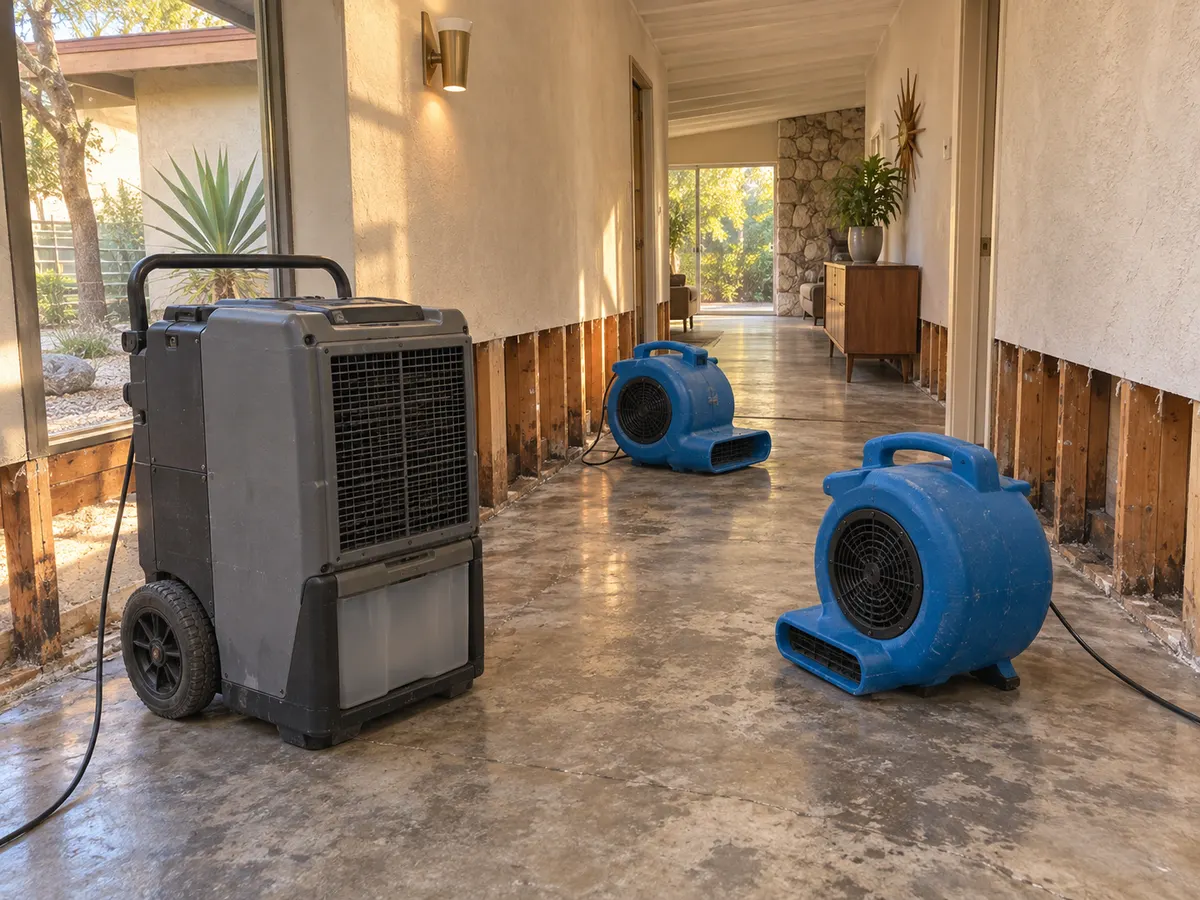
Water mitigation is the work that stops damage from spreading: extraction, removal of materials that cannot be dried, and controlled drying with dehumidifiers and air movers. For a San Fernando Valley homeowner, it is the first phase of a water damage job.
Humidity matters as much as standing water. The EPA recommends keeping indoor humidity below 60 percent and drying wet materials within 24 to 48 hours[EPA]. Even in a dry climate, a closed room full of wet drywall and carpet becomes humid fast.
Typical steps
- Inspect. Find the source and map how far the water went.
- Extract. Remove standing water from floors and carpet.
- Remove. Cut out drywall, insulation and pad that will not dry.
- Dry and monitor. Daily moisture readings until materials are dry.
Do
- Keep interior doors open to the wet area unless the crew says otherwise.
- Use fans, air conditioning and dehumidifiers to help drying[CDC].
Avoid
- Painting or covering walls before readings show dry.
- Turning off the equipment overnight.
Signs you need water damage restoration, not just a mop
- Water has been sitting for more than a day, or you do not know how long it was there
- Carpet is wet across a room, or the pad squishes when you step on it
- Drywall is soft, stained or swollen at the bottom
- Water came through a ceiling or reached a second room
- The water came from a toilet, drain or the outside
- There is a musty smell after the surface has dried
These point to water inside the building materials. Surface drying will not reach it.
Common causes of water damage in the San Fernando Valley homes
- Water heaters. Tanks rust through at the bottom, and relief valves and supply connections drip. In many Valley homes the heater sits in a garage or a closet next to finished rooms.
- Washing machine hoses. Rubber supply hoses crack with age and can release water at full line pressure until someone closes the valve.
- Toilets and supply lines. A failed fill valve, cracked tank or loose supply line can run for hours, often while nobody is home.
- Air conditioning condensate. A clogged drain line backs up the drain pan, and the overflow lands in the ceiling below or on the floor around the air handler.
- Refrigerators and dishwashers. Ice maker lines and dishwasher connections leak slowly under cabinets, where the water can sit for weeks.
- Winter storms and roof leaks. Heavy rain finds its way in around flashing, vents and windows, and contaminated wind-driven rain counts as Category 3 water[IICRC 2026 position statement].
The source matters because it sets the water category and the starting point for moisture mapping.
Clean water, gray water and sewage: the three categories
The IICRC splits water into three categories. Its examples of grossly contaminated Category 3 water include sewage, waste line backflows from beyond a trap, seawater flooding, rising rivers or streams and contaminated wind-driven rain[IICRC 2026 position statement].
It also changes how the crew works. With Category 2 or 3 water, removal and cleaning happen first, under contamination controls, and drying comes after; Category 1 can go straight to drying[IICRC 2026 position statement].
Time matters too. The IICRC notes that time and temperature can change the category[IICRC 2026 position statement], so a clean leak left sitting for days can be treated as contaminated water.
What is under the floor matters
Los Angeles City Planning’s history of postwar tract housing notes that these houses often have concrete slab floors rather than raised floors with wood joists[LA City Planning]. Much of the Valley was built in that era, so on many calls the water is on or under a slab.
Older houses are more likely to be raised. The state’s Earthquake Brace + Bolt program, which helps owners retrofit houses on raised foundations, ranks ZIP codes partly by the share of houses built before 1940[Earthquake Brace + Bolt]. In a raised-floor house, a leak can drip through the subfloor into the crawl space and stay hidden.
Either way, the drying plan changes: slab jobs focus on flooring, baseboards and the bottom of walls, while raised-floor jobs add the subfloor, joists and crawl space.
What the restoration crew brings
- Moisture meters. Pin and pinless meters read moisture in drywall, wood and subfloor so the crew can map the wet area and track progress.
- Thermal cameras. Infrared cameras show temperature differences that often point to wet areas behind walls and under floors. Readings are confirmed with a meter.
- Extraction units. Truck-mounted and portable extractors pull water from carpet and pad; submersible pumps handle deeper water.
- Air movers. High-velocity fans move air across wet surfaces so moisture evaporates faster.
- Dehumidifiers. Refrigerant and desiccant dehumidifiers pull that moisture out of the air so it does not soak back into the house.
- Wall cavity drying. Small holes or removed baseboards let air reach the inside of wet walls without tearing out the whole wall.
What can be saved and what usually goes
The deciding factors are the type of water and how long things stayed wet. The EPA says materials that cannot be thoroughly cleaned and dried within 24 to 48 hours should be discarded[EPA flood cleanup guide], and the CDC adds that items which cannot be disinfected, such as wall coverings, cloth, rugs and drywall, should be thrown away[CDC].
With clean water caught early, the EPA notes that wallboard, fiberglass insulation and wall-to-wall carpet may sometimes be dried and saved, though replacing them can avoid indoor air problems later[EPA flood cleanup guide].
Take photos and video of damaged items before they are removed[FEMA].
Sewage backups in the San Fernando Valley
A backup from a toilet, tub or floor drain is grossly contaminated water under the IICRC categories[IICRC 2026 position statement]. The area is closed off, contaminated porous materials come out, and surfaces are cleaned before any drying starts.
LA Sanitation explains the split: the city owns the sewer main, and the private lateral from the house to the middle of the street is the owner’s responsibility. When any plumbing fixture in the home sits below the street manhole cover, a backwater valve is required, permitted through the Department of Building and Safety[LA Sanitation].
Once the house is dry
Ask for a copy of the final readings and keep them with your damage photos. In the weeks after, watch for a damp smell, new stains or swelling floors. Fix the source for good; the EPA is clear that the water problem must be fixed or it comes back[EPA].